A lot of people train hard, but track softly. They go to the gym, do their exercises, vaguely remember what they lifted last time, and rely on feeling, memory, or chance. That works for a while. Then progress stalls.
That is usually the point where three terms start showing up: workout tracker, fitness app, and bodybuilding logbook. They sound similar, but they are not the same thing. The difference is simple: most people are looking for motivation. But if you want to build muscle or strength over the long term, what you really need is measurability.
That is exactly why the real question matters: What do you actually need?
The classic bodybuilding logbook
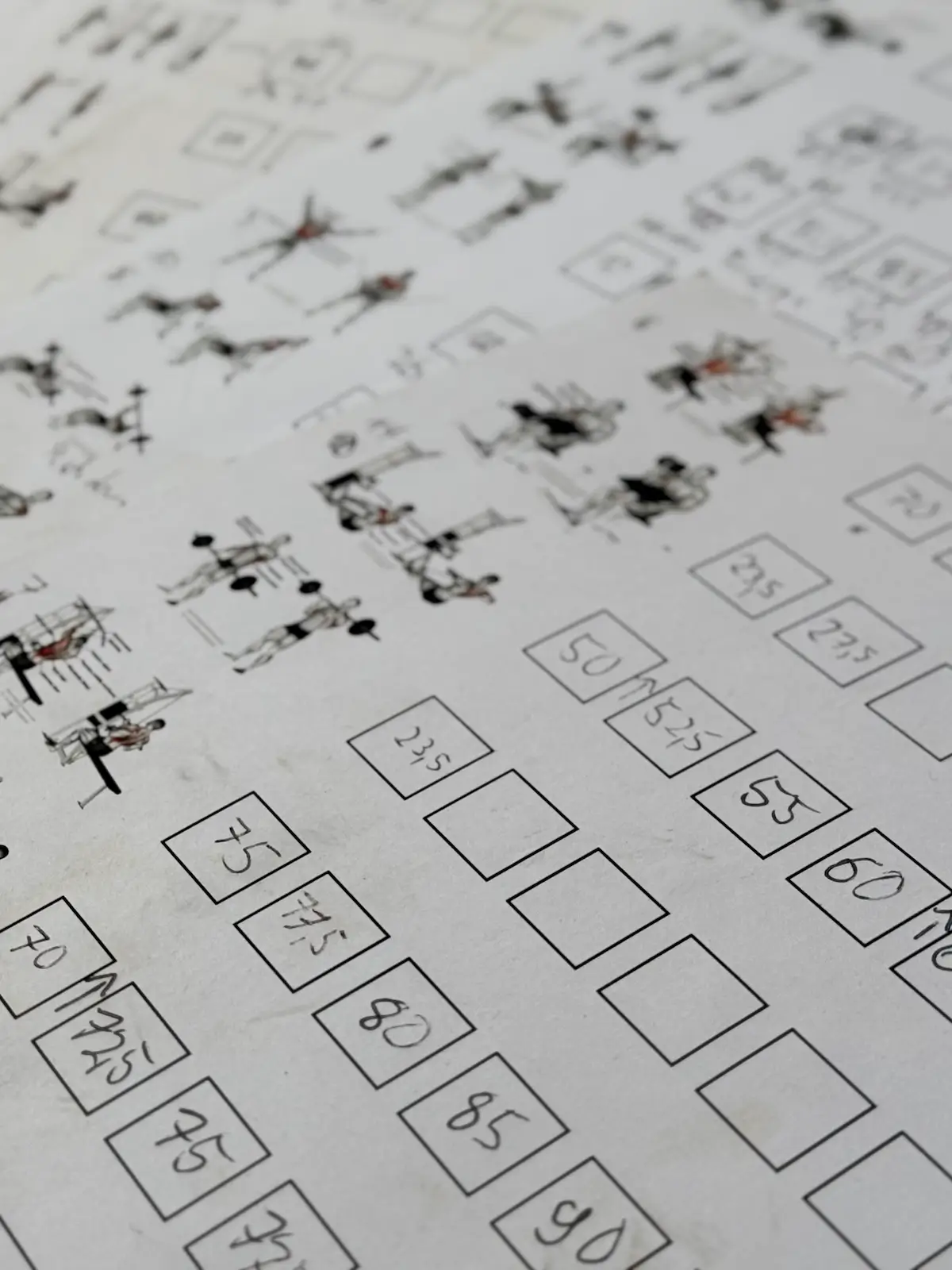
They have been around for decades: squared notebooks, ring binders, sometimes even printed training journals with preformatted tables. The paper bodybuilding logbook is the original ancestor of workout tracking. No battery, no updates, no distractions.
You write down what you did. Exercise, weight, reps, sets. Maybe a short note in the margin: "shoulder felt off" or "felt strong today." That is it. No algorithm judging your training. No push notification congratulating you. Just you and your numbers.
And that is exactly its strength. A logbook does not lie. It does not motivate you, and it does not punish you. It simply shows you what happened. If you benched 80 kilos last week and only 77.5 this week, it is right there in black and white. No spin, no framing.
But a paper logbook has limits. It cannot visualize progression over months. It cannot calculate training volume. It cannot filter, sort, or compare. And if you lose it, everything is gone. No backup, no export. Just an empty feeling and a new notebook.
For purists, a paper logbook remains an honest tool. But it is a tool from a time when there simply was no better alternative.
The typical fitness app
Open the App Store and search for "fitness." You will get hundreds of results. Most of them promise the same thing: train better, live healthier, see results faster. Along with that come animations, badges, challenges, leaderboards, and social features.
The problem is this: these apps are built for everyone. For the runner, the yoga enthusiast, the casual gym-goer, and the ambitious strength athlete. And that is exactly why they are not truly great for anyone.
If you want to track serious strength training, you quickly notice where things start to break down. Logging sets and weights feels clunky. Creating custom exercises is either impossible or locked behind a paywall. Want to see progression clearly over several weeks? Good luck. Instead, you get motivational quotes and a calorie counter.
Fitness apps are generalists. They can do a little bit of everything, but nothing especially well. For someone who jogs three times a week, that may be enough. For someone trying to get systematically stronger, it is not.
But the biggest problem is something else entirely: many fitness apps treat training like entertainment. Gamification, streaks, social sharing. That keeps users inside the app, but it does not make them stronger. Motivation through distraction is not a sustainable concept. And sooner or later, everyone realizes that badges do not build muscle.
What a real workout tracker does differently
A workout tracker is not an all-rounder. It is not trying to do everything. It does one thing, and it does it properly: track strength training, analyze it, and translate it into measurable progress.
That starts with input. A good workout tracker understands that between two sets, you do not have time to dig through menus. Logging has to be fast. One tap, one swipe, done. Adjust the weight, change the reps, move on to the next set. No detours.
Then there is history. A workout tracker does not just show you what you did today, but also what you did last week, last month, and last quarter. You can see at a glance whether you are getting stronger, stalling, or slipping backwards. Not as a feeling, but as a number.
And then there are routines. A workout tracker lets you build fixed training plans you can follow week after week. No surprises, no random suggestions. You know exactly what is waiting for you before you even walk into the gym.
At the same time, a workout tracker should not treat heart rate and Apple Watch integration like foreign objects bolted on at the side. They should feel like a natural part of the training experience.
That exact interplay was one of the reasons why VigiGym 3.0 introduced Live Activities, real-time sync between iPhone and Apple Watch, and integrated heart rate tracking. The rest timer runs directly on the Lock Screen. Heart rate is not measured in a separate app — it becomes part of the active workout. And every change on the Watch appears instantly on the iPhone. No reloading, no waiting, no break in the flow.
That is the fundamental difference compared to a fitness app: a workout tracker does not treat your training as content. It treats it as data. And data is the basis for decisions.
Why so many apps miss the point of strength training
Strength training is not very sexy in the App Store sense. It does not fit neatly into 30-second videos. It does not produce dramatic before-and-after photos after one week. And it requires patience, discipline, and repetition — three things that are not especially easy to monetize.
That is why most fitness apps focus on what sells better: guided workouts, challenges, community features. That drives downloads. But it does not help the athlete who has been grinding on their squat for three months and wants to know whether their volume is on point.
The problem runs deeper. Many apps are built by teams who do not actually train seriously themselves. They understand the theory, but not the day-to-day reality. They do not know what it feels like to handle inputs with sweaty hands and chalky fingers. They do not know that moment between two heavy sets when all you want to do is log one number, fast.
That is exactly why so many apps fail at input. They rely on keyboard entry, even though nobody wants to type in the gym. They ask for three taps where one would do. They show you a pretty animation when all you actually want is to start the next set.
VigiGym took the opposite route: no keyboard inside the training log. Instead, sliders and wheels that still work with sweaty hands and gloves. That sounds like a small detail, but it is precisely the kind of decision that reveals whether an app was designed from actual training experience or from behind a desk.
Which solution makes sense for whom
Not every solution is wrong for everyone. It depends on what you expect from your training, and how serious you are about progress.
A paper logbook makes sense if you train in a minimalist way, do only a limited number of exercises, and do not mind giving up analysis. It is honest, simple, and costs almost nothing. But it does not scale.
A fitness app makes sense if you are just getting started, trying different sports, and want a broad overview. It motivates, entertains, and gives you the feeling that you are doing something. But it usually does not document training with enough precision for real progression.
A workout tracker makes sense if you train systematically, want to increase your loads over time, and make decisions based on data. It is not a motivation tool. It is a measurement tool. And that is exactly what makes it valuable for anyone who takes strength training seriously.
The question is not which tool is best in general. The question is which tool fits your training goal. If you want to get stronger, you need measurability. And if you want measurability, you need a tracker.
Why VigiGym deliberately refuses to become a fitness circus
VigiGym has no challenges. No leaderboards. No social timeline where you can share your workouts. And that is intentional.
The reason is simple: everything that does not directly serve the training itself is a distraction. Every feature you add is a feature that has to be maintained, tested, and understood. And every feature that demands attention steals attention from the real purpose: training better.
VigiGym is built for athletes who know what they are doing. Who do not need a virtual coach telling them when to train. Who do not need to collect points to stay motivated. Who simply want a tool that works.
The three principles behind VigiGym are clarity, speed, and usability. Clarity means you instantly see what you need. Speed means no loading bars, no waiting. Tactile usability means it still works with gloves, with sweat, and after your fifth heavy set.
That is not modesty. It is a design decision. One that deliberately leaves out everything that does not serve progress. Not because it could not be done, but because it does not need to be.
"If you take progress seriously, you cannot rely on memory. A good logbook does not replace intuition, but it exposes self-deception."
Summary for the impatient
- The bodybuilding logbook is honest and functional, but inflexible. Good for purists, weaker when it comes to analysis and convenience.
- The typical fitness app is broad in scope, but often too generic and too playful for serious strength training.
- A real workout tracker is a tool for measurable progress: clear routines, fast input, precise history.
- Strength training needs structure, not entertainment — if you want to get stronger, you need to track loads, reps, and progression properly.
- VigiGym deliberately positions itself as a workout tracker — not a social fitness app, not a coach, but a precise training tool.
Frequently asked questions
What is the difference between a workout tracker and a fitness app?
A workout tracker is specialized in precise strength training documentation: exercises, weights, reps, sets, and progression. A fitness app, by contrast, covers a much broader range — from yoga and running to nutrition — and rarely goes deep enough when it comes to strength training.
Is a paper bodybuilding logbook still relevant today?
Yes, absolutely — for purists. A paper logbook is honest and functional. But it has limits: no automatic analysis, no one-tap progression view, no backup. Anyone training long term will eventually run into those limits.
Do I need an Apple Watch for VigiGym?
No. VigiGym works fully on the iPhone. The Apple Watch expands the experience with heart rate tracking, wrist-based input, and live sync — but it is not a requirement.
Can I use VigiGym to track cardio or yoga?
VigiGym is deliberately focused on strength training. That means no half-baked cardio features, but full depth where it matters most: sets, weights, reps, and measurable progression.
Ready to level up?
Free to download. Smarter to train.


Achim Loobes
Solo developer, athlete, and the person behind every pixel of VigiGym. Coding since the eighties. Training for decades. Building software not for investors, but for use in real life. Based in Mönchengladbach, Germany.